
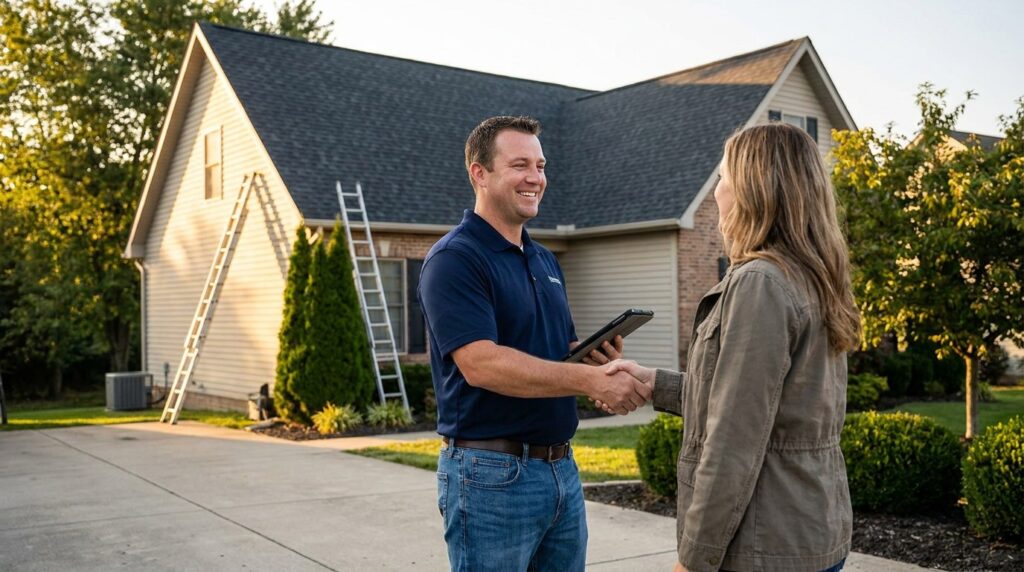
Roofing sales is one of the few careers where you can earn six figures on roughly 40 hours a week with no degree. That is true only if you treat it like a real job and pick the right company to work for.
Most people who wash out of this business did not fail because they could not sell. They failed because they signed on with the wrong company (no training, trial by fire, company is in a bad financial situation). This guide covers the honest pros and cons, what it takes to succeed, and what to look for in a company before you say yes.
The pros of roofing sales
The money is real. A solid rep at a good company can earn six figures, and top performers earn well beyond that. Few jobs pay this well without a degree or a license that takes years to earn.
You are the ceiling. Your income is tied to what you produce, not to a title or how long you have been there. Nobody has to retire for you to move up.
The schedule is flexible. You run appointments, not a time clock. If you need to make a school pickup or a doctor’s appointment, you can usually build your day around it.
You have freedom. You are not standing on a line or sitting under fluorescent lights for eight hours. You are in your truck, in neighborhoods, and at kitchen tables.
No degree, no roofing experience needed. You can start earning in weeks instead of spending four years and tens of thousands of dollars to qualify.
The skills go with you. Learning to listen, present, handle objections, and ask for the business pays off in any career, including running your own company someday.
You help people. A roof is one of the biggest purchases a homeowner makes. A good rep takes a stressful problem and makes it simple.
The cons of roofing sales
Income can be uneven. Commission means great months and lean months. Your first 60 to 90 days are usually the leanest, which is why paid training matters so much.
Weather and seasons run the calendar. Severe weather cancels inspections. Depending on where you live, winter can slow things down.
You will hear “no” a lot. Even if you are good at sales, you will lose about half of your appointments. If rejection or awkward, sometimes tense conversations ruin your week, this job will wear you out.
Flexible does not mean nine to five. Homeowners are home on evenings and Saturdays, so some of your best appointments happen then.
It is physical. You will climb ladders and walk roofs in the heat and the cold.
Freedom cuts both ways. Reps who treat a flexible schedule as a part-time schedule earn part-time money. The ones who put in a real 40 hours, every week, are the ones who win.
What it takes to succeed
You do not need sales experience. You do need these:
- Hungry and humble. You want to win, and you are willing to be coached. Reps who follow a proven process beat reps who wing it.
- Comfortable with heights. Even though you are not installing the roof, dangers still exist.
- You answer your phone. Homeowners call when it suits them. The rep who picks up gets the job. These calls come at all times of the day. Salespeople work never and always.
- Basic computer skills. Expect a CRM, measurement software, digital presentations, and e-signatures. You do not need to be an expert, but you cannot be afraid of a tablet.
- Self-discipline. Use the time between leads for revenue-generating behavior (follow-up, door knocking, referral work, social media content, training).
- Comfortable talking about money. You will discuss five-figure projects with strangers at their kitchen table.
- A reliable vehicle and a valid license.
What to look for in a roofing company
The company you choose matters more than your talent. Two reps with the same ability can end up with very different incomes depending on where they work. Look for these five things.
1. A W-2 position
Many roofing sales jobs are 1099, which means you are an independent contractor. You pay both halves of payroll taxes, buy your own health insurance, and get no unemployment or workers’ comp coverage if something goes wrong on a roof.
A W-2 role means the company withholds your taxes, covers you on its workers’ comp, and often offers benefits. It also tells you something about the company: it is investing in you as an employee.
2. Paid training
You should not have to go broke learning the job. Look for a company that pays you during training through a salary, a training wage, or a guaranteed base for the first few months. A company that pays you to learn has a reason to train you well.
3. Company-assigned leads
Some companies expect you to generate every lead yourself, mostly by knocking doors. Prospecting is a valuable skill, and you should expect to do some. But a company that also hands you booked appointments from its own marketing gives you a much faster path to income.
4. Mostly retail work
Retail means the homeowner is paying for the roof, often with financing. Insurance work means a claim is paying for it after storm damage.
Insurance-heavy companies live and die by the weather. A big storm brings a rush, and a quiet year brings a drought. Retail work is steadier, because roofs wear out every year whether it hails or not. Retail also teaches you to actually sell: building value, presenting options, and offering financing. Retail gives you the tools to succeed in any sales job.
5. A real sales process
Ask to see how they sell. A good company has a defined presentation, a pricing system, financing options, and structured coaching.
Questions to ask in the interview
You are interviewing them as much as they are interviewing you. Ask these before you accept an offer:
- Is this position W-2 or 1099?
- How am I paid during training, and how long does training last?
- How do I get leads?
- What share of your work is retail versus insurance?
- How is commission calculated, and when is it paid?
- Who will train me, and how often will a manager ride along?
- How long have your current reps been here?
- What tools are available to help me succeed (financing, digital sales presentation, weekly coaching)?
Red flags
- Commission only from day one, with no paid training.
- Vague answers about how or when you get paid.
- You have to buy your own leads, equipment, or training.
- Big income promises with no real numbers behind them.
- High turnover, where most of the team has been there less than a year.
The bottom line
Roofing sales can change your income and your life without a degree. It rewards people who show up for a full week, stay coachable, and choose a company that invests in them.
Look for a W-2 role, paid training, company leads, mostly retail work, and a real sales process. Find those five things, treat the job like a job, and the money takes care of itself.
Want help getting there? My Virtual Sales works with both sides of the table. If you are new and want to learn roofing sales the right way, we can show you the process. If you already run a team, we train your reps on that same process, from when the customer calls to book an appointment to the close. Set up a conversation at myvirtualsales.pro.