
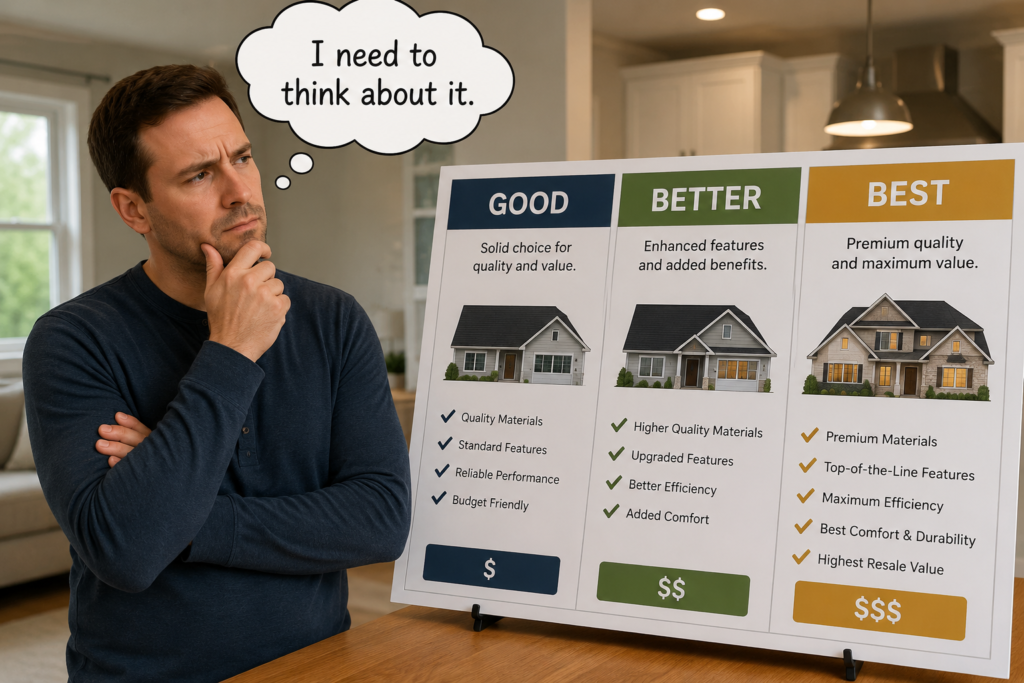
The three-tier pricing menu has become almost a reflex in home services. Good, Better, Best. It feels customer-friendly. It looks professional and hey, if given more options they will buy something right? Wrong, in roofing, it quietly kills more deals than it closes.
Here’s why.
More Options, Fewer Decisions
There’s a well-documented phenomenon called decision fatigue: the more choices a person has to weigh, the harder it becomes for them to choose anything at all. Every option you add to the table is one more thing the homeowner has to evaluate, compare, second-guess, and “think about.” That’s why at the end of a hard day even choosing a TV show can feel like a task.
When you hand someone three roofs, you haven’t made their decision easier. You’ve handed them a research project. And the natural response to a research project is to go do more research, which usually means calling two more companies. Multiple options don’t encourage buying. They encourage shopping. The more choices you put in front of a customer, the lower the odds they make a decision that day, with you, sitting at their kitchen table.
A Roof Is Not a Car
The “Good, Better, Best” model is borrowed from products people are excited to buy. When someone’s configuring a new car, they want to option the leather seats and the sunroof. When they upgrade a phone, they’re genuinely interested in the bigger screen, the extra storage, the third camera. Those upgrades are fun. The tiers tap into desire.
A roof is the opposite. Buying a roof is one of the last things most homeowners ever want to spend money on. There’s no joy in it. Nobody is thrilled to upgrade their underlayment. So the three-tier menu, which works because it invites people to indulge a little, falls flat. They’re not looking to indulge. They’re looking to spend as little as possible to make the problem go away.
The “Good” Price Becomes the Starting Line
This is the part that hurts the most. The moment you put a “Good” option on the table, you’ve shown the customer your floor. And in their mind, that lowest number isn’t the budget option, it’s the real price, and everything above it is the part they’re supposed to negotiate down to or avoid.
You’ve handed them a starting point for negotiation, and you did it to yourself. Now you’re not selling a quality roof; you’re defending why anyone would pay more than the cheapest thing you offered.
Sell What You Want to Sell
The stronger approach is to stop diluting the conversation and lead with the roof you actually want to install. Talk about the best. Build genuine desire for it. Walk the homeowner through why it’s the right answer for their home, their climate, and their long-term peace of mind. Price-condition them for that number before you ever say it out loud, so it lands as reasonable rather than as a shock.
Then ask for the sale on the roof you want to sell. One clear recommendation from a confident expert beats a menu of options from a salesperson every single time. Consumers want a trusted professional to tell them what’s right and stand behind it.
When you remove the “Good” and the “Better” and simply make the case for the best, you stop competing on price and start competing on value, and you give the homeowner permission to do what they actually wanted all along: make a decision and be done with it.
Little secret, those other packages still exist, but only if you need them……
Need help creating a winning package that makes you stand out from other roofing companies in your area? Reach out to My Virtual Sales. Our game-changing package design program will help tailor a pitch built to set you apart, so you’re selling the best instead of defending the cheapest.